Showing posts with label accessories. Show all posts
Showing posts with label accessories. Show all posts
Friday, October 8, 2010
Wherefore Beaver?
Someone in Canada in search of parts has inquired which model of Beaver lathe most closely resembles the Rockwell/Delta 46-140. It is the Beaver 3400 lathe. They have inboard and outboard spindle thread sizes in common, thus faceplates and drive centers will be interchangeable. Just from looking at the photos over at OWWM it is almost certainly the case that the bed ways, headstock and tailstock of the later models will be interchangeable with the 46-140 as well. Look up the Beaver 3400 lathe on OWWM and you'll find considerable information there, including a manual that describes the procedure for removing the spindle from the headstock. The most significant difference (from reading the manuals -- I do not own a Beaver nor have I ever touched a living, breathing 3400) is that the headstock spindle of the older models from the early 50's would accept #2 MT tooling, whereas later ones were solid. I have no idea whether the spindle from one will fit the other or vice versa.


Tuesday, September 21, 2010
Busy Bee
At some point during the past year BusyBee of Canada had redesigned its web site and in so doing invalidated most of the hyperlinks I had made to individual lathe parts. I have since updated the links. Please refer to my previous (and now updated) post.
Wednesday, January 27, 2010
Making A Buffing Shaft
Here is another accessory item that you can make for any lathe, not just the 46-140, that is also an example of where a scroll chuck can come in handy.
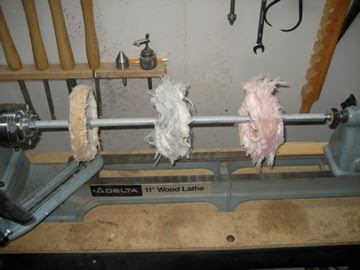
It consists of three stock buffing wheels that I picked up at Sears mounted on a length of 5/8-inch diameter allthread. Although they're not easily seen in this photo, each wheel is held in place on the shaft sandwiched between a pair of nuts, two flat washers and one split washer.

It consists of three stock buffing wheels that I picked up at Sears mounted on a length of 5/8-inch diameter allthread. Although they're not easily seen in this photo, each wheel is held in place on the shaft sandwiched between a pair of nuts, two flat washers and one split washer.
The tailstock end is dimpled for the point of the live tailstock center.
The headstock end of the allthread has a standard connecting nut on it, and is thru-pinned with a common finish nail. The connecting nut is in turn grasped by the scroll chuck.
Each wheel is charged with a different type of polish or rouge.
Simple, cheap and effective.
Saturday, January 23, 2010
Mounting A Wire Wheel
Sometimes you have to take a lot of rust, scale or other crud off of something and you don't want to spend all day cleaning it up with a handheld wire brush and a can of turps. On one such occasion I ginned up the following using a standard wire wheel, a length of 5/8-inch allthread, some nuts and a split washer.

That's a connector nut on the left end, thru-pinned with a finish nail. Here's another look at it.

This end goes in the scroll chuck, obviously. The other end is dimpled to accept the tailstock live center point.
Sunday, January 17, 2010
Pen Turning On The 46-140 Lathe With A Plain-End Pen Mandrel
There are three basic types of pen mandrel, as defined by the method of mounting to the headstock: those having a morse taper shank, those having a threaded female socket, and those having no mounting fixture at all -- the so-called "plain end."
In other words, a "plain end" pen mandrel is basically just a length of straight and smooth round rod with no obvious means of mounting to the 46-140's headstock.

In other words, a "plain end" pen mandrel is basically just a length of straight and smooth round rod with no obvious means of mounting to the 46-140's headstock.
Here's where you get creative. I will explain two similar methods, one for use with a scroll chuck, the other for mounting directly to the headstock spindle.
Let's suppose that you happen to have a scroll chuck with an ordinary 50mm jaw set. Rough turn round and then face off a thick hardwood dowel. Cut off a 3 inch length of it and grasp it in your scroll chuck jaws. Turn down a 1/2-inch long tenon at the tailstock end of that dowel. Drill a 3/4-inch deep hole in the center of that tenon that is just large enough to accept the smooth end of the pen mandrel. Aim for a snug fit. You don't want any play in that hole and it must be perfectly centered. Secure the mandrel in the wood block with a set screw driven into the tenon perpendicular to the axis of rotation. Here's a photo of the finished item. You can see the "tooth marks" where the scroll chuck's jaws grasp the block.

With the mandrel now secured in the wood block, add your pen blank, spacers, etc., tighten it all up, place the dimpled end of the mandrel rod on the point of your tailstock center, and turn your pen.
Alternatively, let's suppose that you have only the factory spur drive center. Unscrew it and set it aside. Now simply tap a hardwood block that is at least 4 inches long by 2 inches square with an ordinary 7/8-14 machinist's tap. Screw it on to the headstock and then follow the above instructions for turning a tenon, etc.
Monday, January 11, 2010
Necessary Fixture-Making Tools
As an alternative to manufactured faceplates and other accessories, with the following tools you will be able to create just about any kind work holding jig or fixture that you might possibly need.
- 7/8-14 right hand, carbon or high-speed steel machinist tap -- for making inboard headstock accessories.
- Morse Taper #1 finishing reamer -- for making headstock fixtures that will hold objects having Morse Taper shanks (e.g. pen mandrels, drill chucks).
- 3/4-16 left hand, carbon or high-speed steel machinist tap -- for making outboard headstock accessories.
- hot melt glue gun and high-strength glue sticks -- for making wooden glue blocks that will hold workpieces without your having to use a tailstock.
The examples of the jigs and fixtures that I will describe in subsequent articles have been created using one or more of the above.
If you have the time and patience, the right hand taps especially can be found quite cheaply on eBay (two or three for the price of one). The left-hand tap and finish reamer are not so cheaply obtained, in which case it is good to cultivate friends who are seriously into souping up cars, ATVs or dune buggies.
Saturday, January 9, 2010
Source of Accessories In The U.S.
Updated 25-Oct-2010
Busy Bee's web site says that they will ship internationally. You have to phone them however to ascertain shipping costs. I don't know how recent this development is or how expensive it is, but I just happened to notice it this evening. Anyway, at least there is a theoretical possibility that owners of the 46-140 and Beaver 3400 lathes can get parts a little more easily.
N.B. After doing a little more searching I have learned that the Grizzly and Busy Bee faceplates are Steelex brand. These faceplates and their respective inserts will occasionally turn up on Amazon and eBay and various other online tool retailers.
- 8-inch faceplate (unthreaded)
- 4-jaw independent chuck (unthreaded)
- 7/8-14 spindle adapter (for inboard use)
- 3/4-16 left hand spindle adapter (for outboard use)
I personally do not own any of the above so I can't vouch for the quality of the items. If you have one or more of these you are invited to post a comment to this article for the benefit of those who follow.
I have since acquired a Steelex faceplate. See this post.
Friday, January 8, 2010
Canadian Source of Parts and Accessories
N.B Hyperlinks updated as of 21-Sep-2010.
U.S. Shipping info added 25-Oct-2010
- 6-inch faceplates (already threaded for 7/8-14)
- 8-inch faceplate (unthreaded) and required 7/8-14 spindle adapter (for inboard turning) or required 3/4-16 left hand spindle adapter (for outboard turning)
- 6-inch, 4-jaw independent chuck (for holding square and irregularly shaped objects) and required 7/8-14 spindle adapter or required 3/4-16 left hand spindle adapter (for outboard turning)
- 6-inch, 3-jaw independent chuck (for holding square and irregularly shaped objects) and required 7/8-14 spindle adapter or required 3/4-16 left hand spindle adapter (for outboard turning)
- 7/8-14 insert for Nova scroll chucks
- Cole jaw set for Nova chucks
- No-name brand scroll chuck and required 7/8-14 spindle adapter.
- Accessory pin jaw set for no-name scroll chuck, above.
- MT#1 live tailstock center
Subscribe to:
Posts (Atom)