Showing posts with label 46-140. Show all posts
Showing posts with label 46-140. Show all posts
Friday, October 8, 2010
Wherefore Beaver?
Someone in Canada in search of parts has inquired which model of Beaver lathe most closely resembles the Rockwell/Delta 46-140. It is the Beaver 3400 lathe. They have inboard and outboard spindle thread sizes in common, thus faceplates and drive centers will be interchangeable. Just from looking at the photos over at OWWM it is almost certainly the case that the bed ways, headstock and tailstock of the later models will be interchangeable with the 46-140 as well. Look up the Beaver 3400 lathe on OWWM and you'll find considerable information there, including a manual that describes the procedure for removing the spindle from the headstock. The most significant difference (from reading the manuals -- I do not own a Beaver nor have I ever touched a living, breathing 3400) is that the headstock spindle of the older models from the early 50's would accept #2 MT tooling, whereas later ones were solid. I have no idea whether the spindle from one will fit the other or vice versa.


Tuesday, March 2, 2010
Steelex Faceplate and Spindle Adapters
I received a Steelex 8-inch faceplate (D 1088) and a pair of inboard and outboard spindle adapters (D 1096 and D 1105) as a birthday gift. These were obtained from Amazon.com for substantially less than other sources (19.50 USD for the unthreaded faceplate, 7.80 USD for each adapter).
The adapter mounts to the rear of the faceplate and is held in place by three rather small hex head cap screws. I spun up the outboard side first and turned the lathe on at its slowest setting. A slight wobbling of the faceplate was detectable by eye and by feel. Ditto for the inboard side. For the sake of comparison, no such imbalance is detectable with my Nova chuck. I shall have to spend some time with these to determine whether or not a little shimming of the adapter will get it to run true.
Tuesday, February 2, 2010
Replacement Headstock Spindle Bearings
Fortunately for me, I have never had to replace the spindle bearings on my lathe. However, the guys over at OWWM who have traveled this road before highly recommend that you call the Accurate Bearing Company for parts and guidance. Here is some important guidance on how best to proceed with placing your order.
At the time of this posting, here's a link to the only discussion I can find over at OWWM on how to remove the headstock spindle and bearings for the 46-140 and similar Beaver lathes. If you're at all unsure how to go about it then by all means join OWWM and post a question there.
Wednesday, January 27, 2010
Making A Buffing Shaft
Here is another accessory item that you can make for any lathe, not just the 46-140, that is also an example of where a scroll chuck can come in handy.
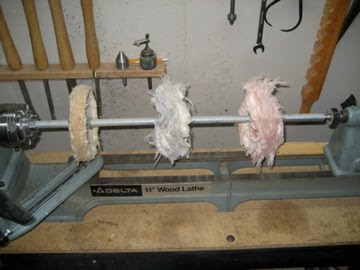
It consists of three stock buffing wheels that I picked up at Sears mounted on a length of 5/8-inch diameter allthread. Although they're not easily seen in this photo, each wheel is held in place on the shaft sandwiched between a pair of nuts, two flat washers and one split washer.

It consists of three stock buffing wheels that I picked up at Sears mounted on a length of 5/8-inch diameter allthread. Although they're not easily seen in this photo, each wheel is held in place on the shaft sandwiched between a pair of nuts, two flat washers and one split washer.
The tailstock end is dimpled for the point of the live tailstock center.
The headstock end of the allthread has a standard connecting nut on it, and is thru-pinned with a common finish nail. The connecting nut is in turn grasped by the scroll chuck.
Each wheel is charged with a different type of polish or rouge.
Simple, cheap and effective.
Saturday, January 23, 2010
Mounting A Wire Wheel
Sometimes you have to take a lot of rust, scale or other crud off of something and you don't want to spend all day cleaning it up with a handheld wire brush and a can of turps. On one such occasion I ginned up the following using a standard wire wheel, a length of 5/8-inch allthread, some nuts and a split washer.

That's a connector nut on the left end, thru-pinned with a finish nail. Here's another look at it.

This end goes in the scroll chuck, obviously. The other end is dimpled to accept the tailstock live center point.
Wednesday, January 20, 2010
How (Not) To Replace The V-Belt On The 46-140
Someone once asked me for advice on how to remove the headstock spindle in order to replace a worn V-belt. I have personally not had occasion to do that and to be frank I really don't want to risk accidental damage to the spindle itself or to the headstock casting. So if and when the time comes for me to replace the belt on my lathe I'm first going to give one of those flexible link belts a try. Even if it doesn't work out I can always reuse the link belt on my tablesaw.
For those of you who have already determined for yourselves that you're going to install a new V-belt and must therefore remove the spindle to accomplish that task, know that the owner's manual will be of no help to you on this subject. Judging by the lack of information there I'm going to assume that the lathe came from the factory with the V-belt and headstock spindle already in place.
The parts schematic is the only official source of information on disassembly that I know of, but sadly it offers no verbal guidance about the process.
Here's a link to a thread over at OWWM that discusses how to remove the headstock spindle and bearings. (It's not obvious from the thread's title, but a response to the OP's question discusses the 46-140 specifically.) That response may or may not be the complete and authoritative word on the subject but it's all I could find. If you're at all unsure about something posted there don't hesitate to contact the author(s) of that thread via the OWWM site as most OWWMer's are rather helpful folks and are more than willing to share what they know or have learned. If you come upon this article some months or years from the date of this posting, do a thorough search of the OWWM site to see whether or not someone may have subsequently raised this issue. Of course, if you find something really good and useful it would be most appreciated if you would mention it or link to it in a comment to this article. (Refer OWWMer's here, or readers of this blog there, I don't care, as long as the new information you've come across is duly noted for posterity.)
Saturday, January 9, 2010
Source of Accessories In The U.S.
Updated 25-Oct-2010
Busy Bee's web site says that they will ship internationally. You have to phone them however to ascertain shipping costs. I don't know how recent this development is or how expensive it is, but I just happened to notice it this evening. Anyway, at least there is a theoretical possibility that owners of the 46-140 and Beaver 3400 lathes can get parts a little more easily.
N.B. After doing a little more searching I have learned that the Grizzly and Busy Bee faceplates are Steelex brand. These faceplates and their respective inserts will occasionally turn up on Amazon and eBay and various other online tool retailers.
- 8-inch faceplate (unthreaded)
- 4-jaw independent chuck (unthreaded)
- 7/8-14 spindle adapter (for inboard use)
- 3/4-16 left hand spindle adapter (for outboard use)
I personally do not own any of the above so I can't vouch for the quality of the items. If you have one or more of these you are invited to post a comment to this article for the benefit of those who follow.
I have since acquired a Steelex faceplate. See this post.
Friday, January 8, 2010
Canadian Source of Parts and Accessories
N.B Hyperlinks updated as of 21-Sep-2010.
U.S. Shipping info added 25-Oct-2010
- 6-inch faceplates (already threaded for 7/8-14)
- 8-inch faceplate (unthreaded) and required 7/8-14 spindle adapter (for inboard turning) or required 3/4-16 left hand spindle adapter (for outboard turning)
- 6-inch, 4-jaw independent chuck (for holding square and irregularly shaped objects) and required 7/8-14 spindle adapter or required 3/4-16 left hand spindle adapter (for outboard turning)
- 6-inch, 3-jaw independent chuck (for holding square and irregularly shaped objects) and required 7/8-14 spindle adapter or required 3/4-16 left hand spindle adapter (for outboard turning)
- 7/8-14 insert for Nova scroll chucks
- Cole jaw set for Nova chucks
- No-name brand scroll chuck and required 7/8-14 spindle adapter.
- Accessory pin jaw set for no-name scroll chuck, above.
- MT#1 live tailstock center
Saturday, January 2, 2010
Obtaining Replacement Factory Parts
Delta does not seem to maintain online information for this lathe. However, it may be possible to obtain parts or service from one of Delta's factory authorized service centers.
Alternatively, online sites such as ToolPartsDirect or Ace Tool Repair appear to have many but by no means all factory authorized replacement parts available online. (Scroll down past the schematics to see the parts price list.)
As you will discover these are by far the most expensive options for those of you who may be trying to restore a vintage lathe. I have personally not had the need to go this route myself, but would be interested in hearing from anyone who has. Please feel free to post a comment to this article.
I have observed that parts, chisel sets, faceplates, and entire lathes do occasionally turn up on auction sites like eBay (that's how I got my lathe, as it happens). When dealing with headstock accessories in particular, it would be wise to ask the seller to provide the Delta part number that is cast into say, the back of the faceplate. That way you can check it against the published parts list to ensure that you're getting one that will actually fit your lathe. Many sellers don't know or have the means to measure the thread pitch of the items they sell.
You may also have luck finding used machines or parts at the Old Woodworking Machines "Bring Out Your Dead" forum. You must first register with owwm.org in order to participate there, however.
Friday, January 1, 2010
Is This Lathe Right For Me?
If you are new to woodturning generally, or don't have room in your shop for a really big lathe, then in my opinion you can't go wrong with a 46-140 if you find one that has been well taken care of. It's a solid, durable, high quality machine that will certainly outlive you if you treat it well, and you can do a lot with it.
If you already have a large monetary investment in lathe tooling (scroll chucks, faceplates, etc.) and you want to use them on this lathe then you will be successful adapting the 46-140's headstock to any spindle size except 1" 8tpi.
In other words, if you're willing to buy (or have a machinist fabricate) a spindle adapter then anything smaller than 7/8" or larger than 1.25" in diameter will work.
Why won't 1-8 work? A machinist will (or should) tell you that it's either not possible or just plain unsafe to make a thread adapter that goes from 7/8" to 1" because the root diameter (bottom) of a 1" thread is just ever so slightly larger than 7/8". There would be too little if any metal left to keep the adapter all in one piece. So all you folks with 1-8 headstock accessories are out of luck.
Since the headstock spindle will not accept morse (or jacobs) taper tooling you're mostly out of luck here too, unless you have a scroll chuck. Perfectly serviceable MT #1 adapters may be fabricated from hardwood for mounting in a scroll chuck. This will be demonstrated in future blog postings.
Replacing the headstock spindle with a custom machined one is theoretically possible but doing so would be prohibitively costly unless you happened to have a really good machine shop at your disposal. Your money would be better spent on a larger lathe that has an appropriately sized headstock for your existing tooling.
Newcomers to woodturning are understandably reluctant to even think about creating adapters, faceplates or other workpiece-holding jigs on their own, whether out of wood or any other material. For a beginner that would be putting the cart before the horse. But after a reasonable period of time you will come to appreciate that jig/fixture and tool making are a natural part of the woodturner's craft -- and a source of enjoyment and satisfaction in themselves. And that's the Great Secret about why it is possible to obtain this lathe relatively inexpensively -- most folks (and especially beginners) assume that you must go to a commercial source for all of your accessories. It's just not true.
In sum, this lathe should provide many years of good service to beginning and intermediate turners. If and when the day comes that you discover that you want to become a professional bowl or hollow form turner, you can then move up to a dedicated "pro" machine and turn this one over to someone else who, like yourself now, is looking for a high quality machine at a price that an amateur can afford.
What Can This Lathe Do?
I find the 46-140 to be quite versatile. I have turned pens, Christmas ornaments, chair legs, tool handles, rolling pins, gavels, bowls, lamps, salt shakers, pepper mills, jewelry stands, and various candle holders with it.
The "swing" (vertical distance from the lathe bed to the horizontal centerline of the headstock) over the gap is 7-1/2 inches, permitting a maximum workpiece diameter of 15 inches over the gap. (The steel rule shown in the photo measures centimeters on its left edge and inches on its right edge.)

The swing over the remainder of the bed is just shy of 5-1/2 inches, thus permitting a maximum spindle turning diameter of a little less than 11 inches.
The outboard end of the headstock spindle has 3/4-16 tpi left-hand threads. With a suitably sized and threaded faceplate one may turn items having a diameter larger than 11 inches. Alternatively, many turners attach a sanding disk or buffing head to the outboard spindle end.
An Inexpensive Entry Into Woodturning
From the questions I've answered for others in the past, I have learned that I am not alone in having acquired this lathe relatively inexpensively. I paid 85 USD for it some 7 or 8 years ago. For that price it came with a complete set of Delta chisels and a 3-inch faceplate, as well. All I had to do was drive 50 miles to pick it up. I think it was quite a bargain, considering that contemporary lathes of similar size and quality cost at least four times that much.
Why so cheap, especially since there was nothing mechanically wrong with it?
There are three limitations that seem to dictate the price:
- You will have a hard time finding or buying tooling for it because the headstock spindle threads measure 7/8-14 tpi. It seems that the lathe manufacturing industry has settled on 3/4-16, and 1.25-8 tpi as "standard" sizes for auxilliary tooling.
- The headstock spindle is solid. It does not have a Morse Taper socket.
- The tailstock spindle, while it accepts standard Morse Taper #1 tooling, does not have a thru-hole to permit deep drilling, such as one might do with a lamp auger.
In my opinion none of these limitations are or should be considered fatal impediments to buying or using this lathe because they all may be easily worked around. Subsequent blog postings will discuss these matters in more detail.
Tuesday, December 29, 2009
Purpose of This Blog
Every now and again someone will have just acquired, or will be in a position to obtain, a 46-140 lathe and will have various questions about its care and feeding. The purpose of this blog is to assist you in obtaining answers to those questions by collecting as much information as possible about this particular model of lathe in one place, and especially because a lot of the info that's available on the Internet about it seems somewhat limited. I personally own this lathe and have answered questions from time to time via email about it, but I just don't have the time to follow all the online forums anymore. So with luck maybe this blog will help to provide information in a timely manner to the next person who gets his hands on one of these lathes.


Likewise, if you happen to have information about this lathe, or have devised a useful jig or fixture for it, and wish to share that then please let me know.
Subscribe to:
Posts (Atom)